
Blackjack Side Bets: Which Ones Give Players a Fair Shot?
Side bets are where casinos hide their profit. Most offer house edges between 5 and 15 percent. Some are worse. One or two are almost fair.
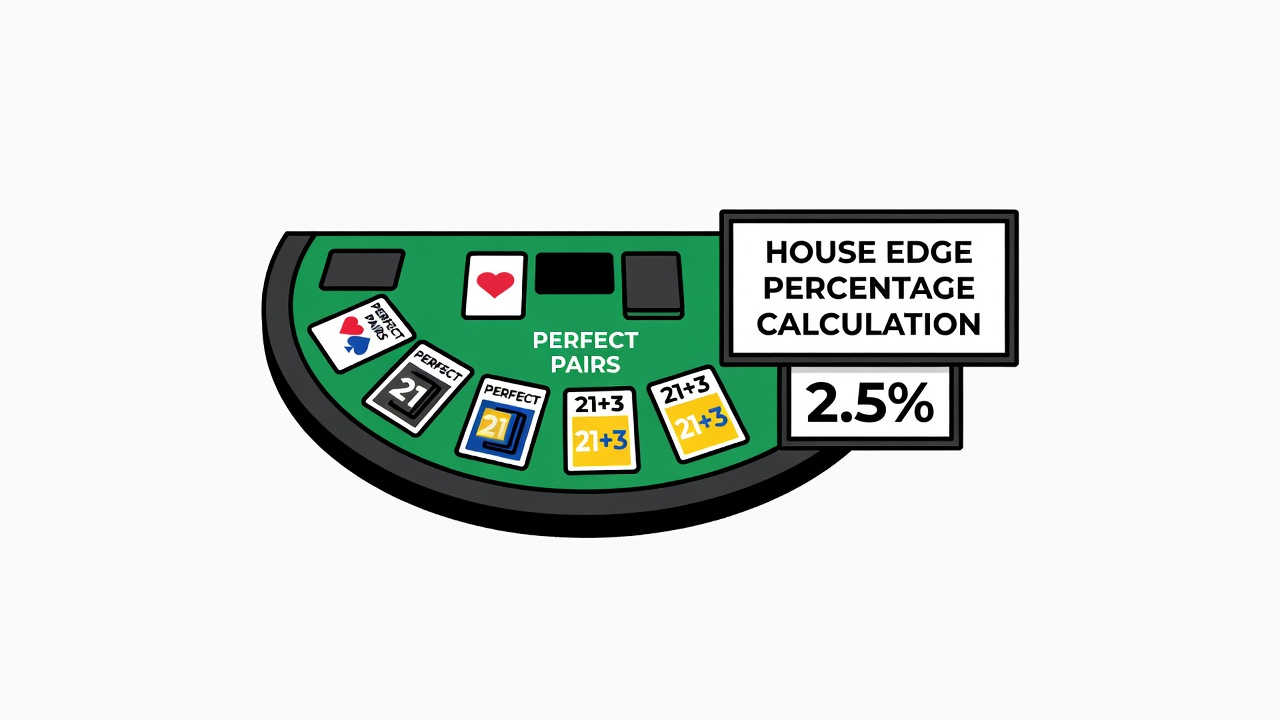
The casino offers you a side bet. Twenty-one plus 3. Bust It. Perfect Pairs. The marketing says "extra winnings" and "enhanced payouts." What it means is: a place to lose money faster.
Start with how side bets work mechanically. You place a regular blackjack bet and optionally place a side bet. The side bet is a separate wager on a specific outcome. Twenty-one plus 3 means your first two cards plus the dealer's first card add up to 21. Bust It means your first two cards will cause you to bust if you hit them. These are resolved independently from your blackjack hand. You can lose your blackjack bet and win the side bet or vice versa.
The house edge on twenty-one plus 3 is roughly 3.2 percent. That sounds almost reasonable until you remember that basic strategy blackjack has a house edge of under 0.5 percent. A twenty-one plus 3 side bet is six times worse than the main game.
Perfect Pairs has a house edge around 2.5 percent, slightly better than twenty-one plus 3 but still five times worse than basic strategy blackjack. Bust It sits around 4 percent. Crazy Eights, Six Card Charlie, Superbonus: all in the 5-15 percent range. The marketing names sound fun. The math is predatory.
Why Casinos Offer Side Bets
Side bets exist because they make money. A standard blackjack game with perfect basic strategy play and deck penetration is barely profitable for the house. Side bets are where the margin lives. A player who places a casual five-dollar side bet every few hands has just increased the casino's profit from that player by an order of magnitude.
The odds offered on side bets are designed to feel close without being close. Twenty-one plus 3 might pay 15 to 2 (7.5 to 1). The probability of the event occurring is roughly 12 percent. The odds should be 8 to 1 (fair pricing). Instead you get 7.5 to 1. The shortfall is the house edge.
This is not random. Every side bet is mathematically engineered. Programmers build the probability, set the payout, and calculate the house edge. The payout is never generous; it is always just generous enough that the bet feels like it might be worth making.
Some side bets are worse than others. Literal casino-inside information: Pragmatic Play offers their side bets with house edges ranging from 2.1 to 14.2 percent depending on the variant. The player has no way to know which variant they are playing without reading fine print. A variant of the same game might be twice as bad depending on the programming.
The only side bet worth making is one you do not understand, because understanding it reveals that it is designed to lose.
One exception exists: the EZ Baccarat "Dragon Bonus" side bet on some live games has been beaten by advantage players using mild advantage play, not because the odds are good but because the game rules create exploitable patterns in the long term. But this requires knowing exactly which game variant you are playing and tracking hundreds of hands. For casual players, this is irrelevant.
Why are people attracted to side bets? They offer bigger payouts than the main game. A twenty-one plus 3 bet can pay 100 to 1 in rare cases. Blackjack itself pays 3 to 2. The fantasy of a big payout from a small bet is alluring. This is not stupidity; this is how human psychology works. We overweight rare large outcomes.
Regulators have started requiring that the house edge on side bets be prominently displayed. The UK and Malta require it. Some U.S. states require it. Most still do not. When the house edge is displayed, side bet uptake drops significantly. This tells you something about what people do when given information.
The occasional side bet is not financially catastrophic. If you play blackjack for 100 hands at one dollar per hand, your expected loss on basic strategy is roughly fifty cents. A one-dollar five-card trick side bet over those 100 hands adds another two to three dollars in expected losses. The multiplication of harm is real but not enormous unless you are a frequent play player.
But the casino knows this. They design side bets for volume, not for individual sessions. A five percent uptake on side bets across millions of hands generates millions in additional revenue. The system is designed to capture marginal money from casual hands that would otherwise be breakeven or near-breakeven for the house.
Keep reading
Same market
 HistoryClosing Line Value Calculator: The Math Behind CLV
 GuidesUnderstanding Slot Variance: A Player's Guide
 SlotsBet Size Matters More Than Spin Count
 Live CasinoDeal or No Deal Live: Rules and Expected Value
 GuidesMMA Style Matchups: What The Numbers Miss
 Sports BettingSame-Game Parlays: Fun, But Are They Profitable