
Mines Game at Crypto Casinos: Strategy and Probability
The Mines game is a bet-shaping mechanism that exploits loss aversion. Players know they can quit, but each uncovered square creates a mini sunk-cost decision that compounds across time.
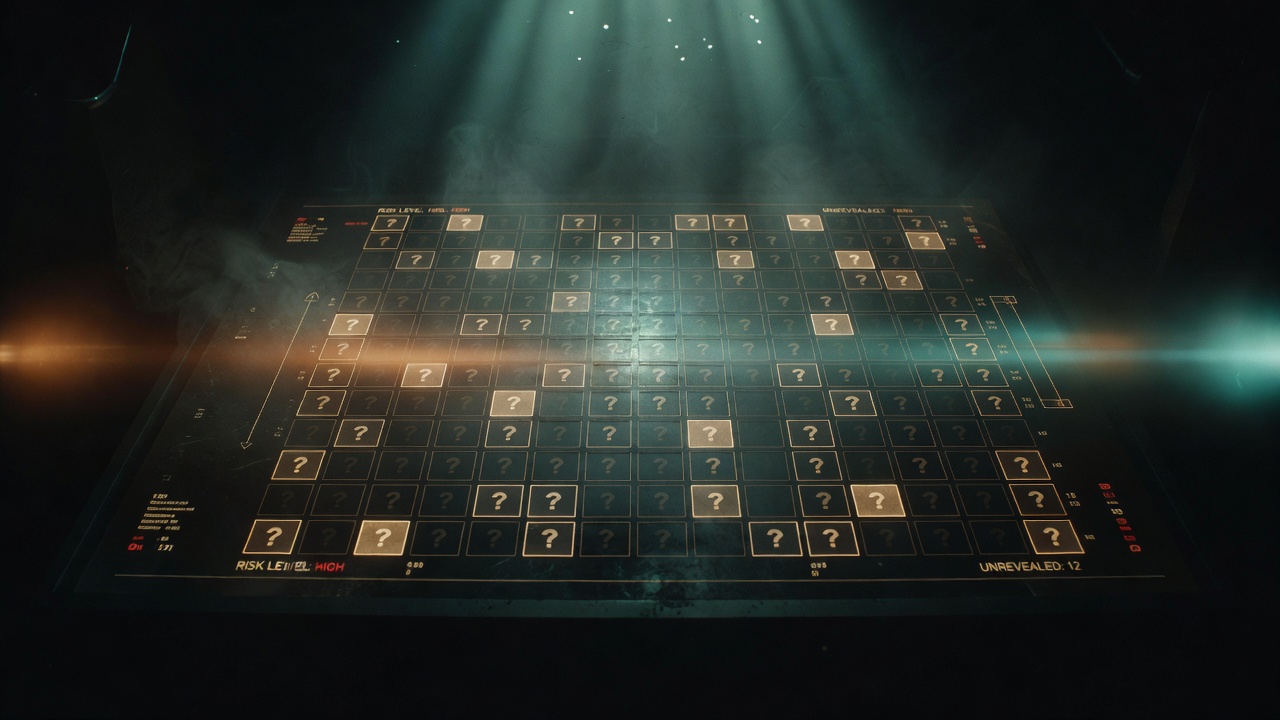
The Mines game first appeared in crypto casinos around 2019, likely as a Pragmatic Play variant. The mechanics are simple: a grid of 25 tiles, some containing "mines," some containing multipliers. You reveal tiles one at a time. Each safe tile multiplies your stake (1.1x, 1.2x, 1.5x, 2x) and creates a new safe bet option. You can cash out at any point. Hit a mine, you lose the bet. This is prospect theory in actionable form.
Richard Thaler and other behavioral economists established in the 1990s that humans weight losses approximately 2.5x more heavily than equivalent gains. This is loss aversion. The Mines game weaponizes loss aversion through what psychologists call the "sunk-cost fallacy." You bet $100. The first tile is safe. Your balance is now $110. The game offers you two paths: cash out at $110 (certain gain of $10) or continue and risk losing $110. Most players continue. The $10 gain is now your reference point, and losing it feels worse than gaining it felt good. Each new safe tile compounds this effect. By the fourth or fifth tile, most players have experienced loss aversion so strongly that they either cash out or play to the point of catastrophic loss.
The Design of Betting Constraints
Mines typically constrains your choices by requiring you to set the number of mines (1-24) before playing. More mines means higher multipliers per tile but higher bust probability. One mine gives you 48 tiles to reveal (48:1 payout at safe completion). Twenty mines gives you 5 tiles (25:1 payout). The payouts are structured such that expected value is identical: EV is negative across all configurations, but the loss rate is constant. This is system design, not accident.
The 1-mine configuration is a retention hook. You can play longer, experience more wins, and more frequently cash out at low multipliers (1.1x, 1.2x). The gambler's fallacy kicks in: you tell yourself "I've been unlucky, so I should keep playing, the luck will change." The fallacy is persistent. Thaler and others documented this behavior in sports betting, horse racing, and casino games. Players who experience bad outcomes increase bet size or extend play as an unconscious attempt to "correct" variance, which is the definition of loss-chasing. Mines is structured to encourage this.
The Mental Accounting of Escalating Stakes
When you cash out a Mines session at +20 percent, the brain treats this as a success. The $100 bet becomes $120. You are up $20. Kahneman and Tversky's work on mental accounting shows that wins are mentally segregated from losses. You are now in a "house money" frame: the $20 gain is not yours, it is the casino's money you have temporarily won. This creates a reframing that makes larger subsequent bets more acceptable.
Other Mines players experience the opposite. They lose three rounds consecutively. The total loss is $300. The loss aversion response is acute: the pain of losing $300 is weighted at 2.5x the pleasure of any potential $300 gain. To correct the deficit, they increase bet size. This is the gambler's ruin mechanism. The loss aversion cuts both ways. Wins feel good but small. Losses feel catastrophic but self-correctable through escalation.
Why Crypto Casinos Love Mines
Mines requires minimal technology (a grid, RNG, payout calculation). It generates high player engagement because each tile reveal is a micro-decision, creating many small dopamine hits per session. It is emotionally engaging in a way that static slot machines are not. The player feels they are exercising control (choosing which tile to reveal, when to cash out), though the outcome is entirely random. This is agency illusion, documented extensively in behavioral finance. People overestimate their influence on outcomes they cannot control.
Stake, Cloudbet, and other crypto casinos promote Mines heavily because it optimizes for time-on-site and bet frequency. A single Mines session might involve 20-30 distinct decision points. A single slot-machine spin is one decision. Mines delivers more decisions per session, more engagement, and more opportunities to experience loss aversion and escalate stakes.
The Honest Math
Expected value on Mines is negative across all configurations. A 1-mine configuration with a 1.02x multiplier per tile has an EV of approximately -2 percent. This means if you play 100 rounds, you expect to lose 2 percent of your stake. A 10-mine configuration with 5 tiles yields the same -2 percent EV. The payouts are calibrated to the probability precisely. You cannot "beat" Mines through strategy because no strategy exists. The outcome is pure chance.
What behavioral economists observe is that players feel like they are making strategic decisions (tile selection) when they are not. The illusion of control is strong enough to encourage longer play and larger bets. The game is designed to exploit the gap between perceived control and actual outcome. Understanding the math requires you to accept that your tile-selection skill has zero impact on the result. Most players cannot accept this, which is exactly why the game works.
Markets in this line
Keep reading
Same market
 HistoryClosing Line Value Calculator: The Math Behind CLV
 GuidesUnderstanding Slot Variance: A Player's Guide
 SlotsBet Size Matters More Than Spin Count
 Live CasinoDeal or No Deal Live: Rules and Expected Value
 GuidesMMA Style Matchups: What The Numbers Miss
 Sports BettingSame-Game Parlays: Fun, But Are They Profitable