
How Bookmakers Set Their Odds: A Look Behind the Scenes
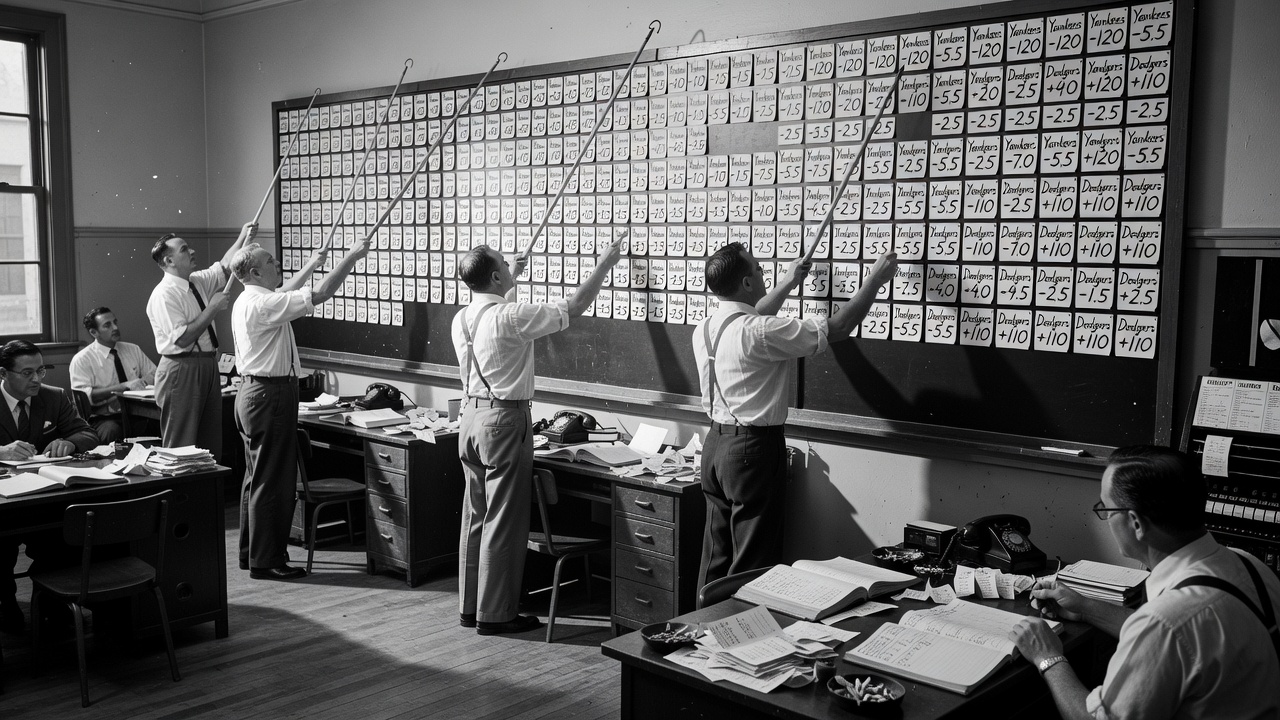
The Austrian School of economics treats all human action as revealing preference. A man buys a lottery ticket. That reveals he prefers the psychological state of imagining winning to the financial cost of the ticket. A woman bets the Kansas City Chiefs at minus six. That reveals her subjective valuation of their victory probability at minus six.
A bookmaker's job is not to be right about outcomes. A bookmaker's job is to price bets so that they make money regardless of outcome. This is the margin, or the vigorish, or the "juice."
The Opening Line
A bookmaker opens an NFL game with a line: Chiefs minus six. This means the bookmaker believes the Chiefs will win by six, or it means the bookmaker has priced the uncertainty such that the line generates balanced action. Often, it is the second.
The bookmaker hires analysts. These analysts look at team strength, injuries, weather, home-field advantage, public sentiment, and injury trends. They produce an estimate of the true probability. The true probability is their honest assessment of game outcome.
Then the bookmaker adjusts. If the analysis says Chiefs minus 5.5 is fair, the bookmaker might open at Chiefs minus six to attract action on the underdog. The bookmaker is not trying to be right. The bookmaker is trying to balance money on both sides.
The Marginal Utility of Money
Imagine a bookmaker receives 100,000 pounds on the Chiefs minus six and 80,000 pounds on the Chiefs at plus six. The bookmaker loses 20,000 pounds if the Chiefs win. The bookmaker gains 80,000 pounds if the Chiefs lose.
That is unbalanced exposure. The bookmaker wants to adjust the line to attract money on the Chiefs. So the line moves to Chiefs minus 5.5 or even Chiefs minus five. Now more bettors want to bet the Chiefs. Money balances. Risk is managed.
The bookmaker does not care who wins. The bookmaker cares that money is balanced and the margin is collected.
The Public
Public betting is predictable. The public overvalues favorites. The public overvalues recent good performance. The public chases narratives.
A bookmaker knows the public will bet heavily on the favorite. So the bookmaker creates incentive for underdog bets by setting the favorite at slightly worse odds than the true line. This attracts underdog money and helps balance the book.
The Sharp Money
Sharp bettors (professional bettors) are harder to balance against. Sharps use data and models to find value. When a sharp finds a mispriced line, they bet large and move the line.
A bookmaker respects sharp money. When sharp money starts hitting the underdog, the bookmaker recognizes that the underdog is probably underpriced. The line adjusts rapidly.
Public money moves lines slowly. Sharp money moves lines quickly.
Closing Lines and Value
The closing line is the final odds before the game starts. The closing line is the most honest odds because it reflects all available information and all intelligent money.
Bettors who consistently beat the closing line are edge-players. They found value before sharps did. They made money.
Bettors who consistently lose to the closing line are value-ignorant. They bet on preference or narrative instead of value. They lose money.
The Inefficiency
A perfect market would have no margins. Odds would reflect true probability exactly. Sports betting markets are not perfect. They have margins. They have biases. That creates opportunity.
The Austrian School teaches that prices reveal preference. In betting markets, prices reveal collective preference weighted by betting volume. A heavy-money underdog might be correctly valued, or it might be the consensus of a group of casual bettors.
Finding value means finding mispricings before sharps correct them. That is the game.
Markets in this line
Keep reading
Same market
 Sports BettingPlayer Prop Line Movement: News Clocks and Injury Tags
 GuidesNo Vig Fair Odds Calculator: Three Methods, Worked Through
 HistoryClosing Line Value Calculator: The Math Behind CLV
 GuidesUnderstanding Slot Variance: A Player's Guide
 SlotsBet Size Matters More Than Spin Count
 Live CasinoDeal or No Deal Live: Rules and Expected Value