
Jerry Patterson's Craps Roll: Fact or Casino Legend?
Jerry Patterson claims to have won millions at craps through controlled throwing. The claim raises philosophical questions: What constitutes proof? When is skill real and when is it illusion?
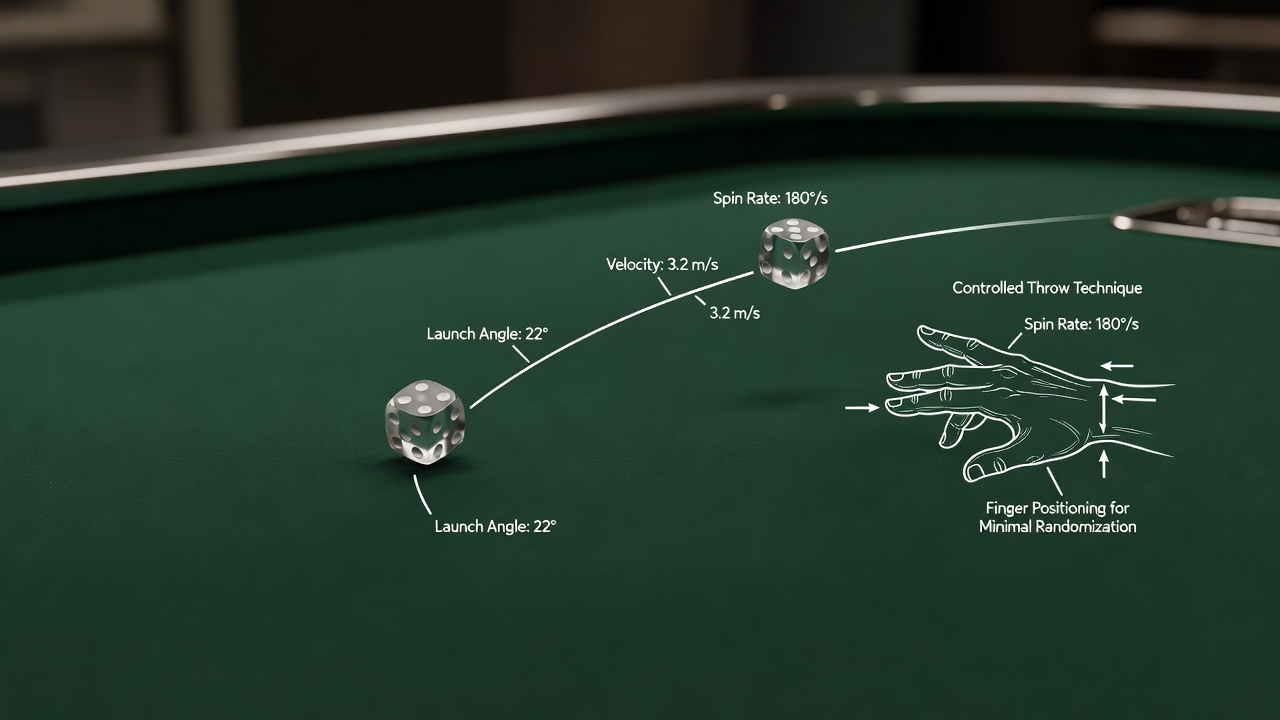
One asks: what is a miracle, and what is merely an event that we do not yet understand? Jerry Patterson, a man from New Jersey, claims to have beaten craps through controlled throwing. He says that by throwing the dice with precision, he can influence the outcome. This is called dice control or precision shooting. Is it real, or is it what we might call, in modern language, a legend that satisfies our desire to believe that chance can be mastered?
Patterson claims to have won millions at craps tables across Las Vegas in the 1970s. He did so, he says, by learning to throw the dice in such a way that certain outcomes became more likely. A seven would come less frequently. A pass (a roll that wins the pass line bet) would come more frequently. He published a book about this: "Break the Dice." The book sold well. Many people wanted to believe that craps could be beaten.
One must ask the first question: what evidence supports this claim? Patterson offers testimonials. He offers his own account. He offers the claim that casinos changed the rules to stop him (they moved further away from the craps table, requiring longer throws, making precision control impossible). These accounts are consistent with a man who had genuine success. But consistency is not proof. A fiction can be perfectly consistent.
The Question of Control
The philosophical question underneath is this: can the human hand throw dice with enough precision that the outcome is not random? Mathematicians and physicists have examined this. The consensus is: theoretically, yes. If you could control the initial conditions of the throw (velocity, rotation, angle of release, spin), you could predict the outcome. But in practice, the variation in any throw is so large that meaningful control is impossible. The air resistance, the micro-variations in hand strength, the distance traveled, all create too much chaos.
However, some studies have found that skilled practitioners can produce throwing patterns that deviate slightly from random. A deviation of, say, 5 percent improvement on a single outcome (one more seven per twenty throws, instead of 3.33, you get 3.5). Over thousands of throws, this small edge compounds. If Patterson threw thousands of times and maintained a 5 percent improvement, he could generate significant winnings.
But here is the deeper question: how would one prove this? Patterson would need to produce casinos' records of his wins. He has not. He would need to be tested under controlled conditions (independent observers watching his throws). He has not submitted to this. He claims the casinos barred him (which they do bar suspected advantage players), but no independent verification of his skill exists.
The Legend Function
What does the Patterson legend do? It tells us something we want to believe: that chance is not absolute, that human skill can override randomness. This is comforting. It implies that we are not merely subject to luck, that our actions matter. The legend serves a psychological function. Whether it is true is almost secondary.
Consider: if Patterson's claims were definitively proven false, would people stop believing them? No. The appeal of the belief is stronger than the evidence against it. Casinos discourage precision shooting by changing rules and barring known advantage players. If casinos thought the threat was zero, they would not bother. Their response suggests the threat is real enough to warrant defense.
But this is also a weak inference. Casinos change rules preemptively against many threats (card counting, collusion, bonus abuse) that are real. They change rules against some threats (precision shooting) that may not be real but feel plausible. The precaution does not prove the threat.
What Is Actually True
One can say this: dice control, if it exists, provides a microscopic edge. Not enough to generate millions of dollars in profit without massive volume and perfect execution over years. Patterson's claims of millions in winnings are more consistent with luck (a streak of unusually good rolls) or with memory distortion (remembering the wins, forgetting the losses) than with skill-based advantage.
One can also say this: Patterson's book has sold thousands of copies. People have paid money to learn his method. Whether or not the method works, Patterson has profited from the claim. This creates an incentive to maintain the claim even if it is false.
The honest position is: we do not know. Dice control might be real at a small scale. Patterson might have had genuine skill. But the evidence is insufficient to conclude this with confidence. The claim remains a legend, suspended between belief and skepticism, serving the function of myth in a domain (gambling) where myth is comforting.
Markets in this line
Keep reading
Same market
 Big WinsImplied Probability Formula for Every Odds Format
 HistoryClosing Line Value Calculator: The Math Behind CLV
 Big WinsTerrance Watanabe's $127 Million Loss at Caesars Palace
 PokerMolly's Game: The Real Story Behind the Hollywood Poker Nights
 CelebritiesPamela Anderson's Poker Losses and Baywatch Paychecks
 BaccaratKerry Packer's Legendary Baccarat Loss to Private Banker