
Online Poker vs Live Poker: Which Is Right for You
Online poker and live poker are not the same game with different interfaces. They are different games with different social structures, different pressures, and different victories.
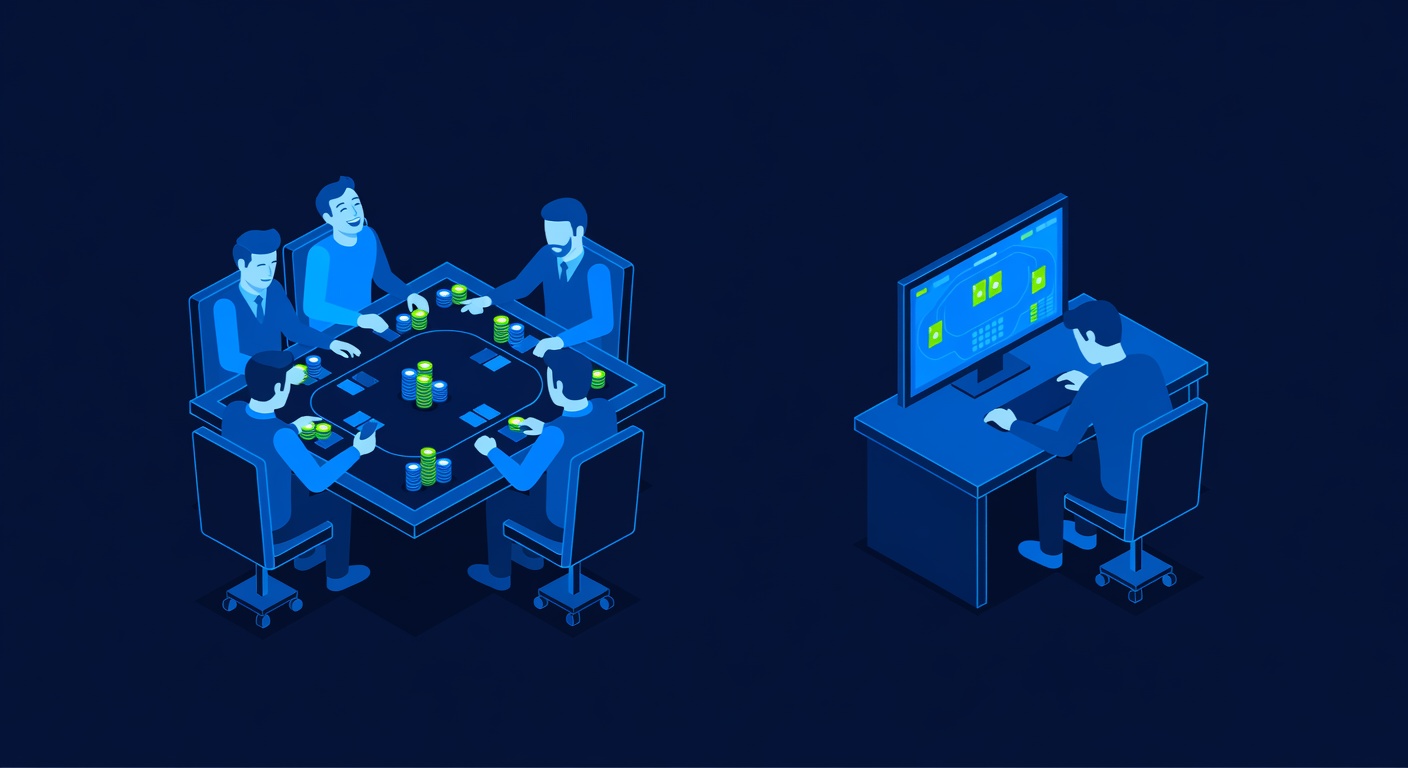
I have spent three years in poker rooms. Underground rooms in Las Vegas, legal rooms in California, offshore poker havens, online platforms. Each has its own gravity, its own rules, its own people.
Online poker is first and foremost silent. No tells, no air. You cannot see another player's face, cannot feel the rhythm of their betting, cannot read the micro-expressions that sometimes signal hand strength. You cannot feel the weight of the chips in your hands. The entire sensory apparatus that human communication relies on is absent. This removes a significant class of edge: the ability to read people.
Online poker is also fast. A hand resolves in ninety seconds instead of five minutes. You see thirty hands per hour instead of twenty. This speed amplifies variance. You win more often if you are better, but you also lose more often if you are worse. The mathematics converge faster. In a live room where you play twenty hands per hour, luck can carry you through a session. In an online room playing thirty hands per hour, luck matters less. Your edge or your leak becomes apparent immediately.
Live poker is social in ways online poker is not. You sit with six to nine other humans for hours. You observe their preferences (do they drink alcohol, do they eat, do they use the bathroom often). You hear their speech patterns (are they friendly, are they tilted, do they lie easily). You see what happens when they win (do they order another drink, do they become careless) and when they lose (do they become tighter or looser). This information is valuable. You are not just playing poker; you are studying humans. The weak players broadcast weakness. The strong players broadcast strength. You adjust.
Live poker also has slowness on its side. A hand takes five minutes. Your brain has time to analyze. You can watch other tables, see patterns, develop theories. You can change your emotional state before you act. A nervous player in an online room plays a hand quickly and irrevocably. A nervous player in a live room has five minutes to calm down, assess, reconsider. The slowness is mercy.
The Social Structure
Live poker rooms have hierarchies that are invisible but rigid. The whales sit at the high-limit tables with comped rooms and cocktails. The grinders sit at the mid-stakes tables with a few thousand dollars and a five-year-old coffee mug. The amateurs sit at the low-stakes tables, drinking beer and losing money slowly. The dealers and room staff are watching all of it. Everyone knows their place.
Online poker has a different hierarchy: the database. Your opponents do not know you personally, but they know your statistics. How many hands you have played (sample size). What percentage you 3-bet (aggression). What percentage you fold to 3-bets (passivity). A skilled online player studies opponent statistics before deciding how to play. A skilled live player studies opponent behavior.
In a live room, the long-term regulars have enormous advantages over tourists. The tourists do not know the soft spots in the room (which table is juiciest, which dealer moves the action fast, which waitress brings drinks promptly). The regulars have played thousands of hours, developed reads on most players at their stakes, and optimized for the room's specific conditions. The tourist comes in, plays a few hours, loses, and leaves. The regular plays three years and becomes a small professional.
Online, the advantage is smaller over long horizons because the opponent pool is enormous and anonymous. You cannot build a years-long read on a username. You can build a database-based read (this username 4-bets too often) within a few hundred hands, but the read is shallow. The advantage is therefore shorter-lived.
The Pressure
Live poker has pressure that online poker does not. You are sitting across from the person you beat. Their reaction is immediate and visible. If you bluff them, you see disappointment or annoyance. If you value-bet them, you see frustration. This creates emotional friction. Some players thrive on this. Others wilt. The toughest live players are often emotionally stable, able to win pots without guilt and lose pots without despair.
Online poker has a different pressure: the relentless pace. You are expected to play quickly. You cannot take five minutes to think about a $500 bet; you are expected to decide in thirty seconds. This pressure favors players with quick intuition. It disfavors players who need time to think. A brilliant live player who is slow might be crushed online because the pace does not allow his thinking process to complete.
The Verdict
Choose live poker if you enjoy the social aspect, read people well, and can afford to play lower-stakes games (because variance is higher in smaller games and you have less money to absorb it). Choose live poker if you want community and are willing to become a regular at one room.
Choose online poker if you play better under time pressure, prefer mathematical precision to behavioral reads, and want to play higher stakes with less social friction. Choose online poker if you want to develop your skill quickly because the feedback loop is faster.
Most skilled players eventually choose online because the mathematics are clearer. The best players, the ones who beat the biggest games, have either developed incredible emotional stability to play live at high stakes, or they have moved to online where the game is faster and the competition is more evenly distributed. The middle ground, the solid player making a living from poker, increasingly finds their edge online.
Markets in this line
Keep reading
Same market
 HistoryClosing Line Value Calculator: The Math Behind CLV
 GuidesUnderstanding Slot Variance: A Player's Guide
 SlotsBet Size Matters More Than Spin Count
 Live CasinoDeal or No Deal Live: Rules and Expected Value
 PokerMolly's Game: The Real Story Behind the Hollywood Poker Nights
 CelebritiesPamela Anderson's Poker Losses and Baywatch Paychecks