
How to Study Poker Hands Away From the Tables
Studying poker away from the table is the mechanism by which skill players separate from recreational players. The off-table work matters more than the on-table hours.
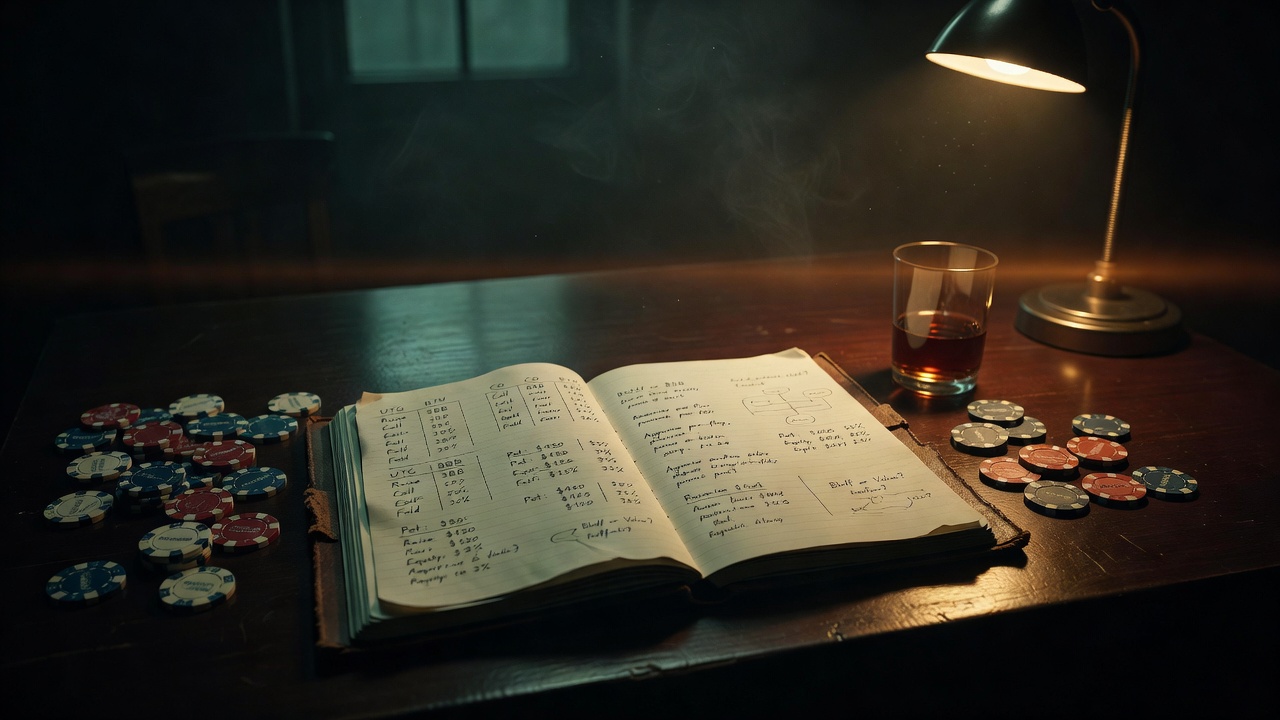
The variable-ratio reinforcement schedule of poker makes it addictive and difficult to learn from. You play a hand, you lose. You play another hand, you win. The randomness makes it hard to extract lessons.
Studying poker away from the table removes variance. You can isolate specific hand types and think deeply about them without emotional temperature affecting your analysis.
The Equity Tool
Modern poker players use equity calculators. You input a hand (AK). You input an opponent's range (TT plus, AQ). You press calculate. The software tells you: AK has 48 percent equity against that range.
That knowledge is powerful. You know that AK is ahead. You know you can raise. You know you can fold to a huge reraise because the equity is thin.
An hour of studying equity takes the place of fifty hours of table play in terms of hand-strength awareness.
Hand History Review
You play a session. You save hand histories. You review them later when you are not emotionally invested.
You played a hand badly (folded too much, called a bet you should have raised). You look at it dispassionately away from the table. You understand why it was bad. You commit to not making that mistake again.
Neuroscience research suggests that learning happens more effectively when emotion is lower. Table review (immediately after losing a big pot) is emotional. Off-table review is analytical.
The GTO Solver
Game Theory Optimal (GTO) solvers take a game state and calculate the unexploitable strategy. You input stacks, positions, blinds. The solver runs simulations (sometimes millions of them). It outputs the mathematically perfect play.
Then you study the solution. You see that you are supposed to check AK on a dry board sometimes. You see that you are supposed to bet only 40 percent of your range from early position.
This knowledge could take thousands of hours of live play to discover through trial and error. A solver gives it to you in hours of study.
The Mental Engagement
Studying away from the table requires different mental engagement than playing. At the table, you are reacting in real time to opponents and information. Away from the table, you are thinking systematically about categories of hands and situations.
Research on skill development (Ericsson, K. Anders) distinguishes between "mere practice" (repeating the same activity) and "deliberate practice" (focused practice on specific weaknesses with feedback).
Table play is often mere practice. You play the same hands from the same positions against similar opponents every session. You repeat patterns.
Off-table study is deliberate practice. You target specific weaknesses. You get immediate feedback (the solver tells you if you are right). You adjust.
The Minimum Standard
Professional poker players typically spend one hour away from the table for every two to three hours at the table. The best players spend more time away from the table than at it.
Recreational players do the opposite. They play but they do not study. They repeat mistakes. They lose money.
The gap between professional and recreational is largely the gap between deliberate study and mere play.
The Practical Method
If you want to improve, establish a routine. Play for four hours. Immediately after, review thirty minutes of hand history. Once a week, spend an hour with an equity calculator or solver working on a specific situation.
That minimal routine (seven hours play, three hours study per week) will separate you from 95 percent of your competition within a year.
The barrier is not intelligence. The barrier is that studying poker is boring. Playing poker is fun. Most people choose fun. The people who choose study eventually become the winners.
Keep reading
Same market
 Sports BettingPlayer Prop Line Movement: News Clocks and Injury Tags
 GuidesNo Vig Fair Odds Calculator: Three Methods, Worked Through
 HistoryClosing Line Value Calculator: The Math Behind CLV
 GuidesUnderstanding Slot Variance: A Player's Guide
 SlotsBet Size Matters More Than Spin Count
 Live CasinoDeal or No Deal Live: Rules and Expected Value