
Edward Thorp: The Mathematician Who Beat Blackjack
Edward Thorp wrote 'Beat the Dealer' in 1962. The book demonstrated that card counting had positive expected value. The casinos changed rules in response. The edge was temporary but the principle was permanent.
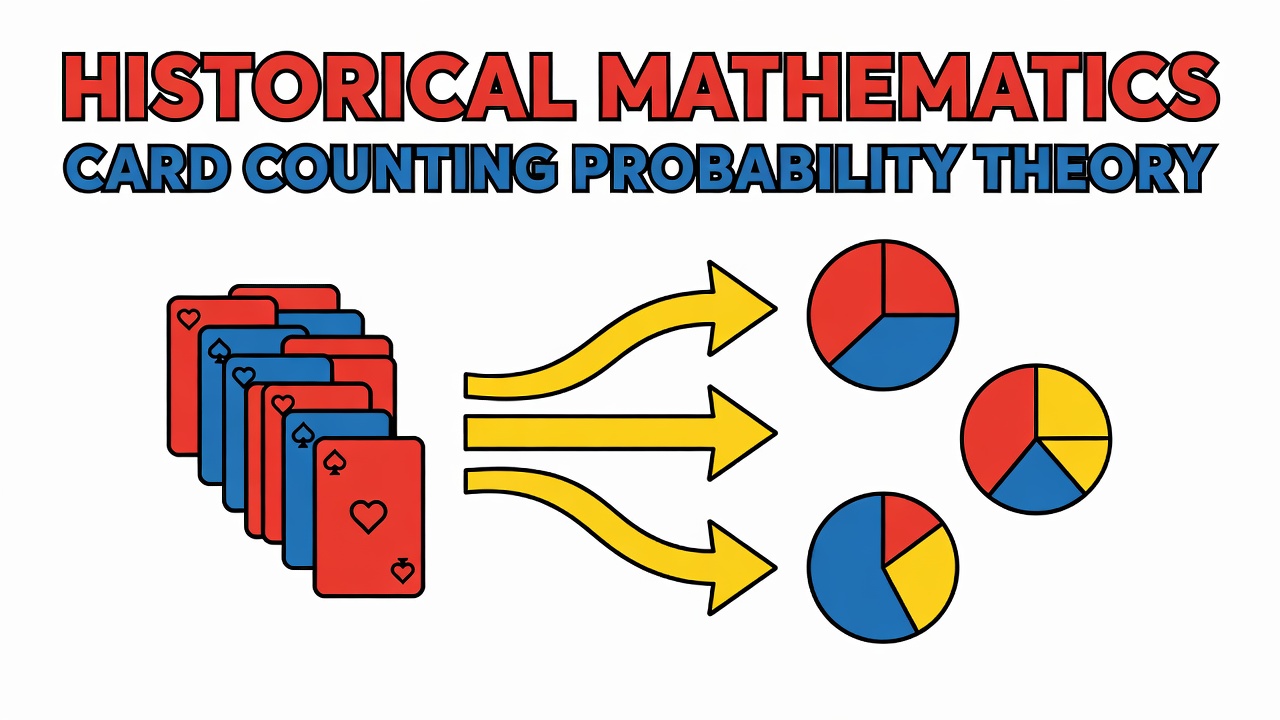
Edward Thorp was a mathematics professor at MIT. In 1958, he became interested in blackjack. Specifically, he became interested in whether the game could be beaten. The question is mathematical: if you have perfect information about the remaining cards in the deck, can you construct a betting strategy with positive expected value?
The answer is yes. Thorp figured this out using an IBM 704 computer, an enormous machine that filled a room and performed approximately 4,000 calculations per second. In 1960-1961, Thorp and his research partner Claude Shannon (the father of information theory) conducted simulations on the 704. They tested thousands of possible betting strategies. They found that a simple counting method (track the ratio of high cards to low cards) combined with basic strategy and bet sizing could generate an edge of 0.5 to 1.5 percent for the player.
Thorp published this in a book called "Beat the Dealer" in 1962. The book was technical but readable. It explained card counting clearly. It showed the mathematics. It demonstrated that casinos had been offering a game with a beatable advantage. The book became famous. Casinos panicked.
Within months, casinos implemented countermeasures. Single-deck games (which were easier to count) were removed. Multiple decks (which made counting harder) became standard. The dealer began shuffling the deck halfway through (rather than dealing all the way to the end), reducing the amount of information a counter could gather. Casinos also began training dealers to spot counters (betting patterns are the key tell) and banning suspected counters from play.
Thorp's edge vanished. The counting systems he described in the book became nearly worthless because the casino rules had changed. This was intentional. The casinos knew they were giving up a small edge (the counter's 1 percent edge, if successful) but gaining a much larger protection (eliminating the threat entirely by changing the rules). It was rational defense.
The Larger Principle
But the principle remained. Thorp had proven that casino games could be analytically approached. That the house edge is not a law of nature but a consequence of the rules. Change the rules, and the edge changes. The implication was radical: if card counting did not work anymore, what other approaches might work? What other asymmetries could be exploited?
Thorp went on to develop other systems. He worked on roulette wheel bias (some wheels have imperfections that favor certain numbers) and prediction. He documented cases of actual biased wheels and calculated the edge that resulted. He showed that prediction systems (based on wheel physics) could produce a small edge, but required precise measurement and computer assistance. These systems were even harder to detect than card counting, so they remained profitable longer.
Thorp's career demonstrated a principle that still governs casino gambling: the edge is mechanical, not mystical. It is a consequence of rules and physics. If you understand the rules and physics, you can sometimes exploit them. If you do not understand them, you lose money.
Card Counting Today
Card counting is no longer profitable in casino blackjack for the same reason Thorp's edge disappeared: the rules changed. But the principle survives. Online poker was beatable (before site operators adjusted rake structures and software). Sports betting is beatable (if you are skilled at predictions and line-shopping). Stock trading is beatable (if you are fast and well-informed). The casino version of this is simple: find an asymmetry, exploit it while you can, and accept that casinos will eventually find a defense.
Thorp's contribution was not merely the counting system. It was the proof that analytical thinking applied to gambling could produce an edge. That casinos were not infallible. That the house margin is not guaranteed. This inspired a generation of quantitative thinkers to approach gambling as a mathematical problem rather than an impossible endeavor. Many succeeded (the MIT Blackjack Team, for instance), at least temporarily.
Thorp himself never made his fortune from gambling. He made his fortune from investments, applying quantitative analysis to stock trading. But his gambling work established the template: measure the rules, simulate outcomes, identify edges, exploit until the rules change, move to the next game. This is the essence of how skilled gamblers approach the problem. Thorp proved it was possible. The casinos confirmed it by changing their rules.
Markets in this line
Keep reading
Same market
 Sports BettingPlayer Prop Line Movement: News Clocks and Injury Tags
 GuidesNo Vig Fair Odds Calculator: Three Methods, Worked Through
 HistoryClosing Line Value Calculator: The Math Behind CLV
 Big WinsTerrance Watanabe's $127 Million Loss at Caesars Palace
 GuidesUnderstanding Slot Variance: A Player's Guide
 SlotsBet Size Matters More Than Spin Count