
Blockers in Poker: How They Shape Bluffing Decisions
A blocker is a card that reduces your opponent's likely holdings. Understanding blockers separates the thinking player from the button mashing.
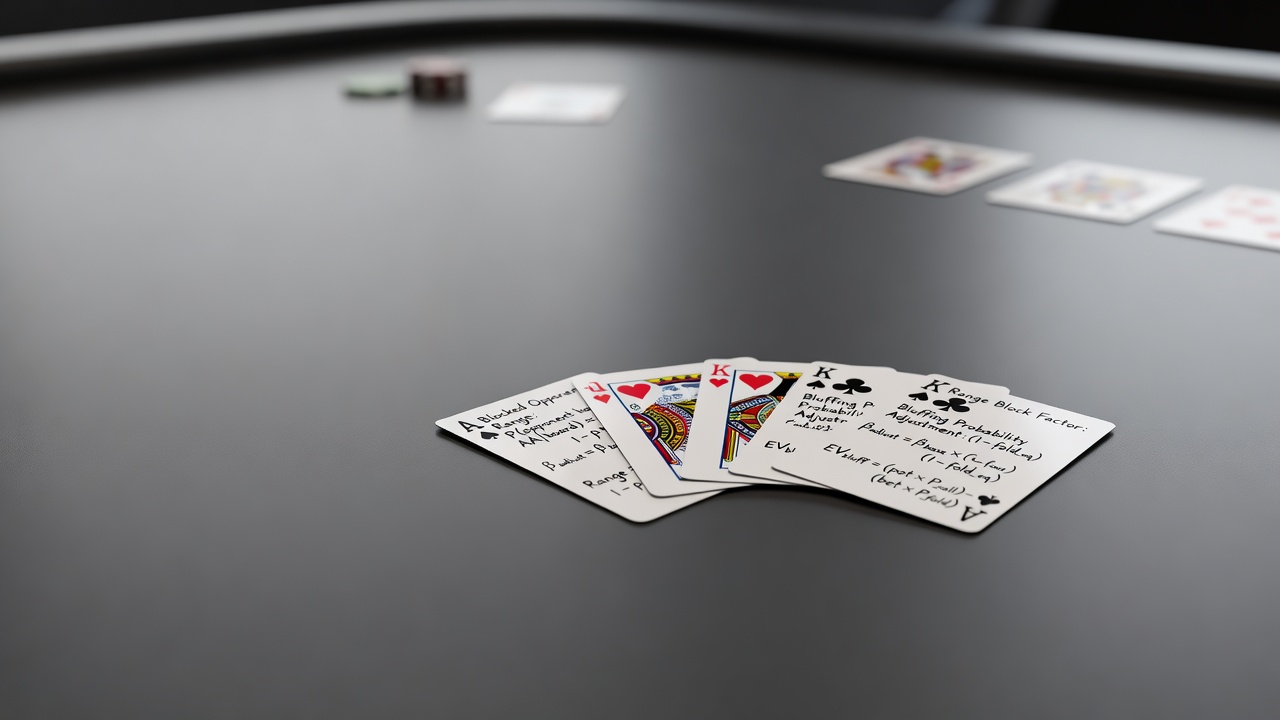
Claim: Blockers are advanced poker theory with no practical application in regular games.
Reality: Blockers are relevant at any stakes because they change the math of bluffing. Here is a concrete example.
You are playing 2/4 pounds with a stack of 600 pounds. An early position player raises to 12. You reraise to 40 from the button with AQ offsuit. Both blinds fold. The early position player calls.
The flop comes 2-7-J. They check. You bet 50. They call.
The turn is a Queen. You now have a pair. They check again. You bet 100. They call again.
The river is an Ace. You check (your hand is strong enough that you want a showdown). They check. You win.
Now let us rewind to the turn. You have AQ. You are strong. But imagine the board is 2-7-8 instead. Your turn card is a blank (say, a 5). You have no pair, no draw to speak of. You are holding AQ with no help.
You check the turn. They bet 100. You decide whether to bluff-raise them or to call.
If you bluff-raise, you are saying "I have a hand strong enough to reraise." What hands can they have? JJ, TT, 99, KK maybe AK. All of these beat you currently. Some of these hands will fold to a reraise. Some will call.
But you hold an Ace and a Queen. The Ace blocks their hand. They cannot have AK (you have the Ace). They cannot have AA (you have one of the Aces). Your AQ blocks their premium holdings.
Without the blocker, you would have 92 offsuit. The 92 does not block anything. The 92 actually increases the likelihood that they have AA, KK, AK, because you have removed no cards that fit those holdings.
The 92 is the same hand texture (whiffed), but it bluffs worse because it has no blockers.
The Practical Application
This changes bluffing frequency. With AQ on a K-T-5 board where you whiffed, you bluff more often (maybe 30 percent) because the Ace blocks their strong hands. With 92 on the same board, you bluff less often (maybe 15 percent) because you are not blocking their value range.
You are not trying to calculate exact equity. You are trying to adjust bluffing frequency based on what hands you remove from your opponent's range when you bluff.
Why This Matters at 2/4
At lower stakes, most players bluff too much. The blocker adjustment helps you bluff correctly. If you have a blocker, bluff slightly more. If you have no blocker and high cards are on the board, check and fold.
The player who understands blockers wins by 0.5bb per 100 hands over time. That seems small. Over a year, it is hundreds of pounds.
The Misconception
The misconception is that blockers matter only when you have absolutely nothing. They matter more when you have a marginal hand. QJ on a K-T-5 board blocks some of their value range (KK, KQ, KJ to some degree). This makes bluffing better than it would be with a totally unrelated hand like 72.
Holding the Queen blocks their KQ. Holding the Jack blocks their KJ. Neither blocker is perfect, but both are better than nothing.
Accordingly, blocker-aware bluffing is an edge-builder, not an advanced esoteric concept. Anyone playing at 2/4 or higher should factor blockers into bluffing decisions.
Keep reading
Same market
 HistoryClosing Line Value Calculator: The Math Behind CLV
 GuidesUnderstanding Slot Variance: A Player's Guide
 SlotsBet Size Matters More Than Spin Count
 Live CasinoDeal or No Deal Live: Rules and Expected Value
 PokerMolly's Game: The Real Story Behind the Hollywood Poker Nights
 CelebritiesPamela Anderson's Poker Losses and Baywatch Paychecks