
Martingale System in Live Roulette: Why It Eventually Fails
The Martingale system doubles your bet after losses, betting you will eventually win. It fails because casinos have table limits.
A man sits at a roulette table at 11 PM. He bets red. It comes black. He loses. He doubles his bet. It comes black again. He doubles again. And again.
This is the Martingale system. The theory is simple: keep doubling until you win. When you win, you profit one unit. The system is mathematically sound in theory. In practice, it is a path to ruin.
The Mathematics
If you lose a series of spins (red, red, red, black), your bets might be 100, 200, 400, 800. You lose the first three for a total loss of 700. You win the fourth with an 800 bet, netting 800 profit. Subtract the 700 loss, you are up 100 net.
Every winning spin nets one unit profit. The system guarantees profit if you have unlimited capital and can make unlimited bets.
Why It Fails
Two problems destroy the Martingale.
-
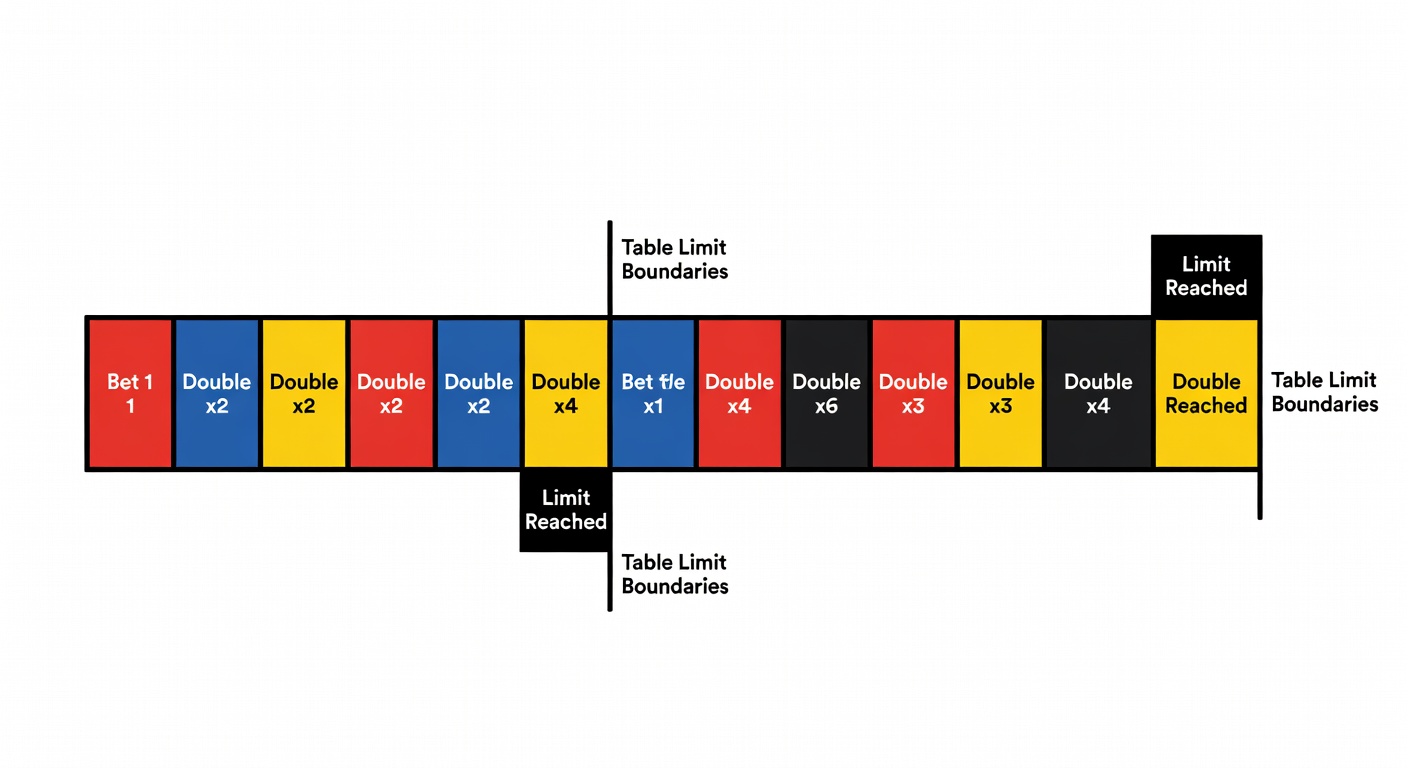
Table limits: Every casino table has a maximum bet. European roulette tables typically cap at 5,000 euros. If you start with 100 and double to the limit after five losing spins, you have exhausted the maximum. The next loss ruins you.
-
Limited bankroll: You do not have unlimited capital. A streak of ten losing spins requires a bankroll of approximately 50,000 to recover (100 base bet, doubling nine times). Most players do not have this.
The Probability
On a European roulette wheel with one zero, black and red each hit with probability 18.5 percent per spin (assuming single-zero roulette). The probability of a specific color missing ten consecutive times is (0.515)^10 or approximately 0.09 percent.
TenPercent is rare but not impossible. In a casino running 100 roulette tables, each playing 100 spins per hour, for 24 hours, you would expect several ten-loss streaks daily across the casino. A Martingale player would bust during these streaks.
Why People Still Try It
The Martingale promises steady income with small upside (one unit per win). This appeals to players who want low risk, consistent returns. The system feels like a mechanism to extract money from the casino.
What actually happens: a player wins steadily for months. Then a ten-loss streak hits. The player doubles and doubles and hits the table limit. They lose their entire session profit plus the original bankroll.
The Mathematical Truth
The Martingale does not reduce house edge. The house edge on roulette is still 2.7 percent (single-zero European) or 5.26 percent (double-zero American) regardless of betting system.
Betting systems do not change underlying probabilities. They only change the distribution of outcomes. The Martingale creates many small wins and occasional catastrophic losses. The average outcome is identical to flat betting: a loss equal to your house edge.
When It Might Work
If you have a bankroll of 1 million dollars and play $1 Martingale spins, you could theoretically survive any reasonable losing streak and profit modestly over time.
But at $1 per spin, your hourly expectation is: (house edge) * (spins per hour) * (1 dollar) = approximately $1-2 per hour. The time invested is not worth the risk.
The Lesson
No betting system beats a negative expectation game. The Martingale is not a system that beats roulette. It is a system that accelerates losses during bad variance and creates a false sense of control when variance is good.
Markets in this line
Keep reading
Same market
 HistoryClosing Line Value Calculator: The Math Behind CLV
 GuidesUnderstanding Slot Variance: A Player's Guide
 SlotsBet Size Matters More Than Spin Count
 Live CasinoDeal or No Deal Live: Rules and Expected Value
 GuidesMMA Style Matchups: What The Numbers Miss
 Sports BettingSame-Game Parlays: Fun, But Are They Profitable