
Crazy Time Explained: Bonus Rounds, Multipliers, and Odds
Crazy Time is a live-dealer game with wheel spins and multipliers. The math shows it is a poor value proposition.
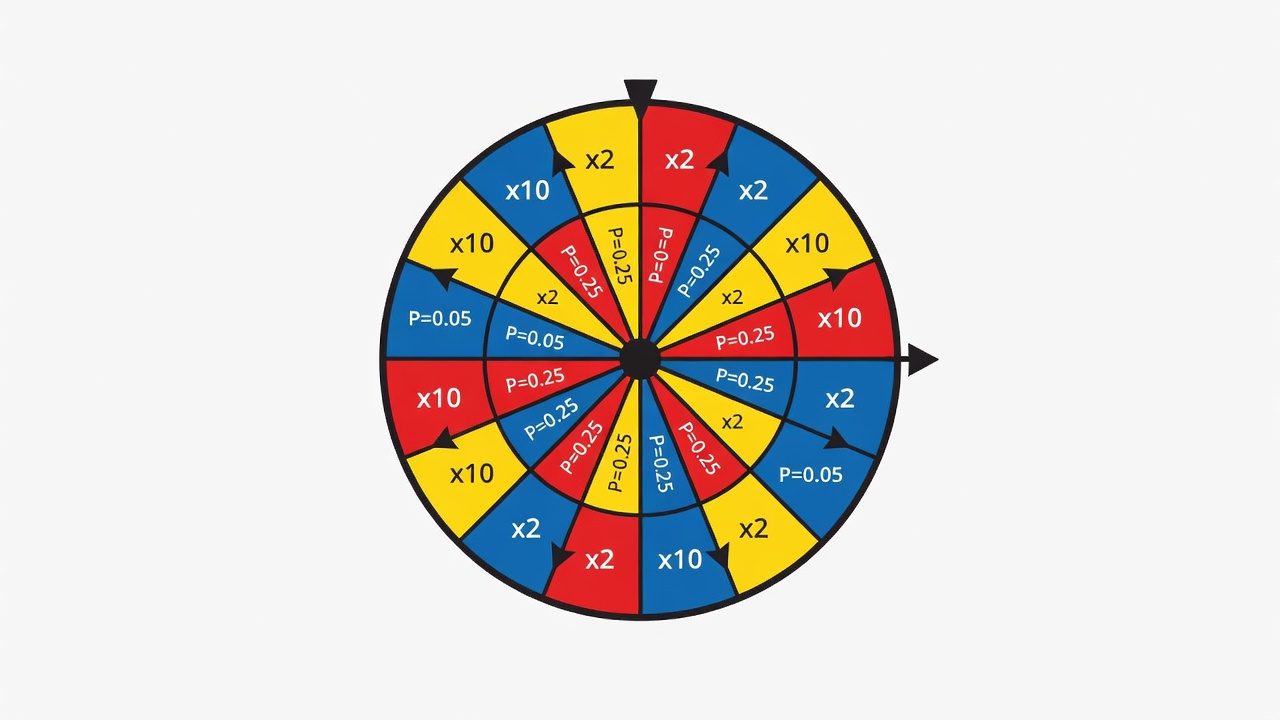
Crazy Time is broadcast live from a studio. A large wheel with numbered segments is spun. Players bet on which segment will be selected. If their segment is selected, they win at predetermined odds. Additionally, random multipliers are assigned to certain segments.
The base wheel has 54 segments: regular numbers (paying at various odds) and bonus rounds (which trigger special games). The probability of landing on any specific number is 1/54 (roughly 1.85 percent). But the game sometimes assigns multipliers to certain numbers, making them worth more.
Example: the wheel has 54 segments. A player bets on segment 7 at standard 30-to-1 odds. The wheel spins. If it lands on 7, the player wins 3,000 dollars on a 100 dollar bet (30 times 100). But if the game has assigned a 2x multiplier to segment 7, the player wins 6,000 dollars instead.
This multiplier mechanism increases the appeal. The possibility of outsized payouts (due to multipliers) makes the game feel more generous. Actually, the multipliers are distributed randomly, and the expected value accounts for them. The game is not more generous. It is equally exploitative with more volatility.
The house edge
Crazy Time's house edge is approximately 8 to 10 percent (depending on the platform and current multiplier settings). This is significantly higher than blackjack (0.5 percent), European roulette (2.7 percent), and most live casino games (1-3 percent).
The 8-10 percent edge means you expect to lose 8 to 10 dollars for every 100 dollars wagered. Over 1,000 dollars in play, you expect to lose 80 to 100 dollars. This is brutal compared to games with lower house edges.
The multiplier system is responsible for the high edge. The house includes multipliers in the odds but makes the multiplier probabilities slightly less favorable than the odds account for. This creates a gap that the house keeps.
Why players like it
Crazy Time is popular because it is exciting. The wheel is large and colorful. The multipliers create big swings. A 50-to-1 multiplier on a 100 dollar bet is 5,000 dollars. The possibility of a 5,000 dollar win off a 100 dollar bet is psychologically compelling.
This psychological appeal drives play despite the high house edge. Players accept the 8-10 percent edge because the game feels fun and the payouts feel generous.
The comparison
Compare Crazy Time to European roulette. Roulette has a 2.7 percent edge. Crazy Time has an 8-10 percent edge. Over 1,000 dollars wagering:
Roulette: expect to lose 27 dollars Crazy Time: expect to lose 80-100 dollars
A player who wants the best odds should play roulette. A player who wants entertainment and does not care about mathematical efficiency should play Crazy Time. The choice is between expected value optimization and entertainment preference.
Strategic play
There is no strategy that beats Crazy Time. The odds are fixed. Betting strategy does not change the house edge. All bets have the same negative expectation.
The only rational approach: play Crazy Time as entertainment, not as a profit vehicle. Set a loss limit (say, 50 dollars). Play until the limit is hit or you get lucky. Accept the 8-10 percent expected loss as entertainment cost.
Markets in this line
Keep reading
Same market
 Sports BettingPlayer Prop Line Movement: News Clocks and Injury Tags
 GuidesNo Vig Fair Odds Calculator: Three Methods, Worked Through
 HistoryClosing Line Value Calculator: The Math Behind CLV
 GuidesUnderstanding Slot Variance: A Player's Guide
 SlotsBet Size Matters More Than Spin Count
 Live CasinoDeal or No Deal Live: Rules and Expected Value